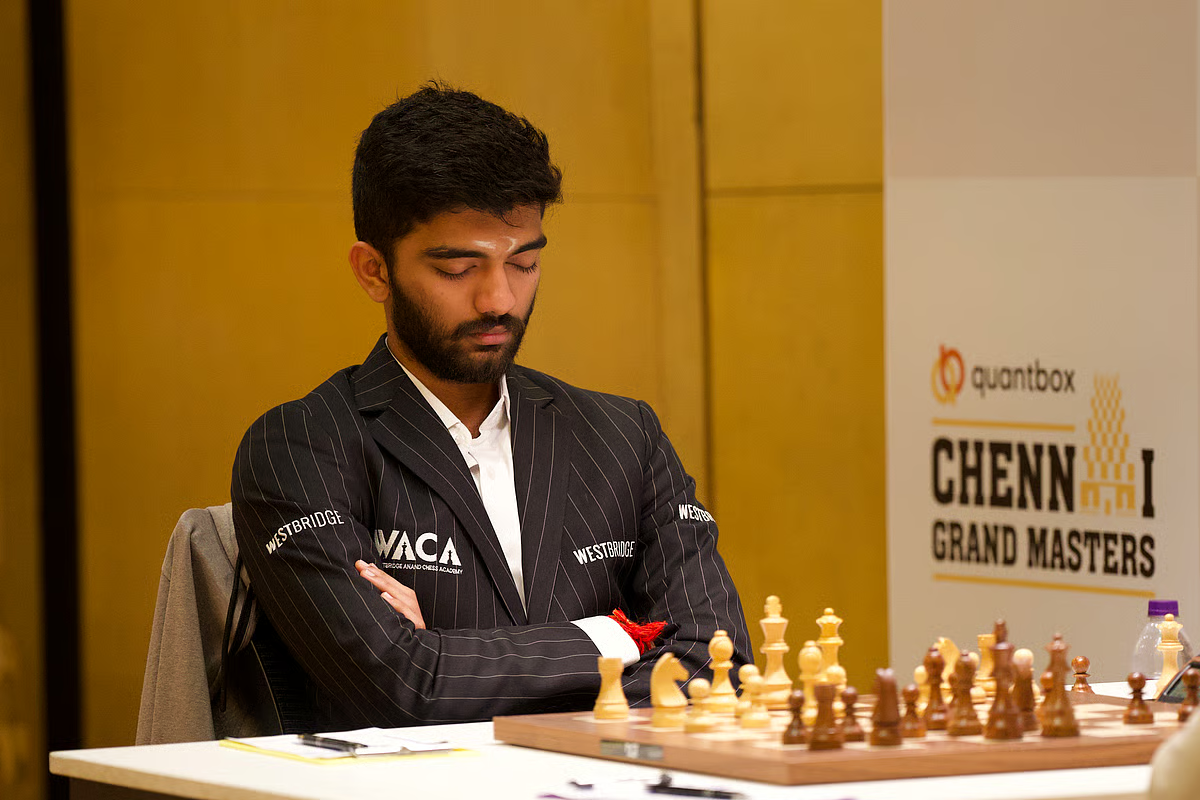
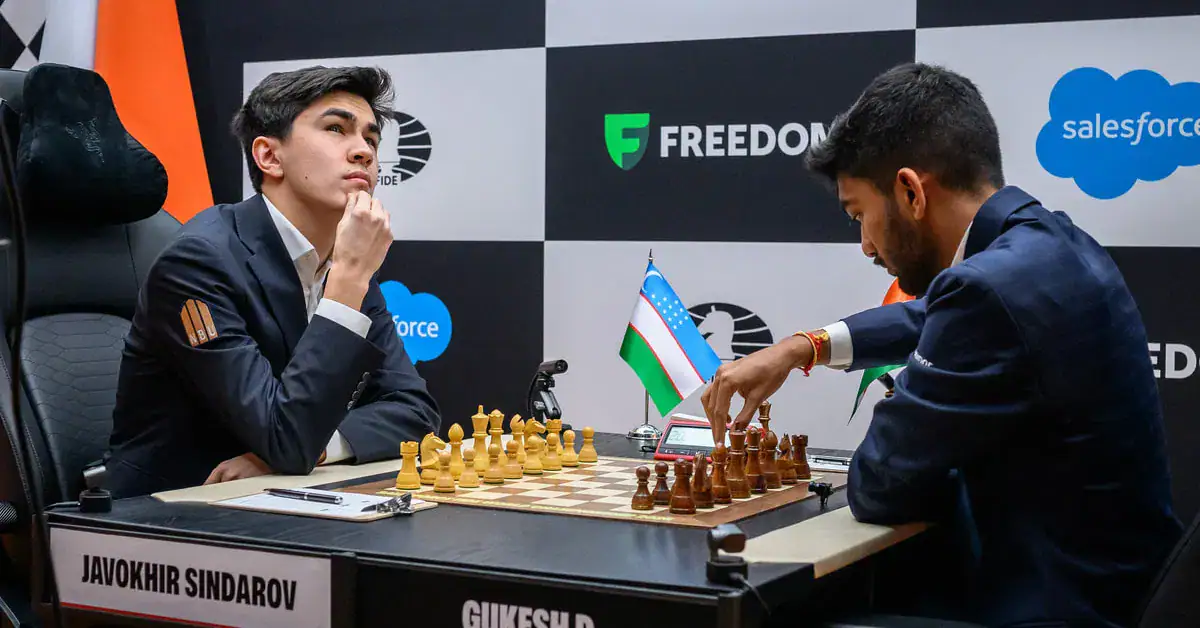
Gukesh Blunders Under Time Pressure as Sindarov Takes 3-2 Lead in World Chess Championship

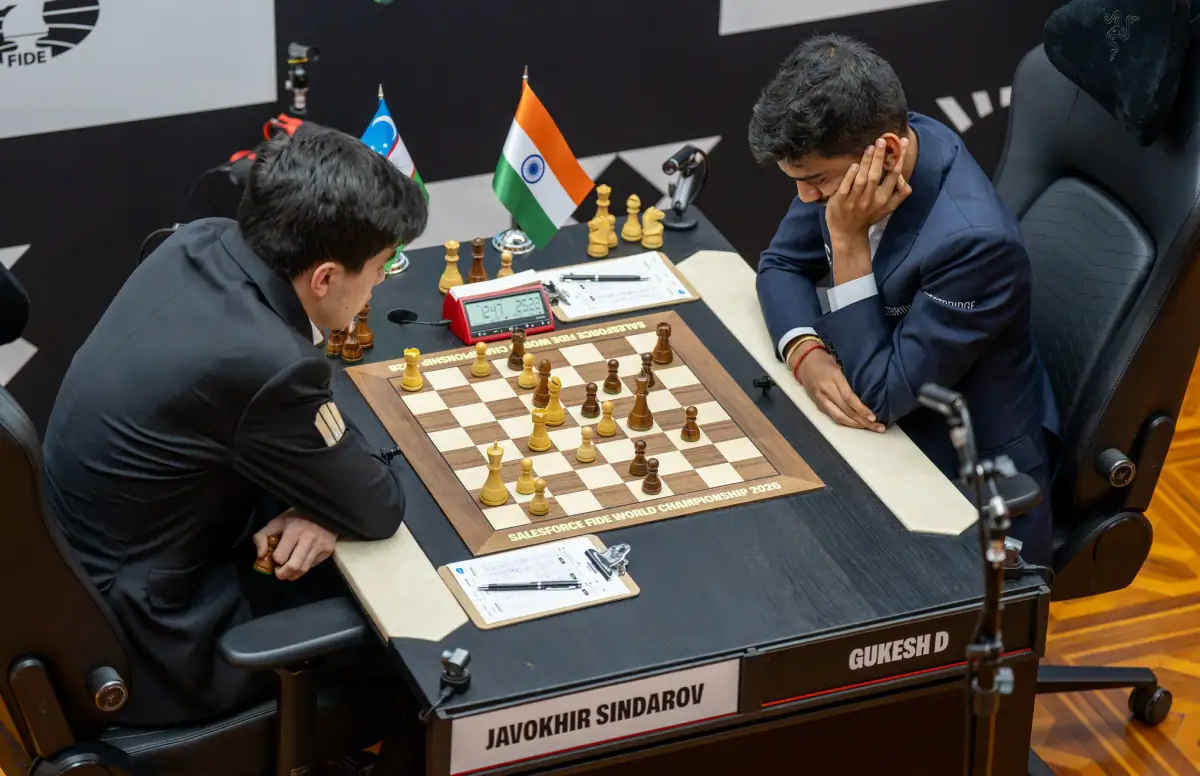
India's D Gukesh suffered his first defeat of the 2026 FIDE World Chess Championship on Sunday, as challenger Javokhir Sindarov capitalised on a critical endgame error to win Game 5 and take a 3-2 lead in the 14-game contest in Geneva.
After four consecutive draws, the deadlock was finally broken at the Fondation Martin Bodmer. Sindarov, playing with the white pieces, secured the full point after Gukesh's decision to exchange queens on move 31 led to a technically lost rook endgame. The result gave the 20-year-old Uzbek his first victory of the match and put the reigning world champion under immediate pressure.
While the final mistake appeared straightforward, the roots of Gukesh's defeat lay much earlier in the game. His time management became a growing concern, forcing him to make critical decisions with little time available as the match approached the first time control.
Sindarov opened with a King's Indian Attack set-up, taking the game away from familiar territory and asking Gukesh to solve several difficult positional questions early. The Indian grandmaster's clock began to suffer almost immediately. He spent 10 minutes on his second move before responding quickly to the next few moves and reaching a familiar structure around move 10.
However, the early rhythm did not last. Gukesh spent 25 minutes and 40 seconds before playing 10...Rd8. Sindarov then pushed 13.e5, creating another demanding decision in the centre. The Indian took 32 minutes and 45 seconds before choosing to centralise his knight with ...Nd5.
Those three lengthy calculations consumed a substantial portion of Gukesh's available time. Although he was able to navigate the early complications, the cost became increasingly visible as the middlegame developed.
For a world championship match, where every decision can influence the course of a game, such early clock expenditure can become a strategic disadvantage. Gukesh was left with less flexibility to calculate accurately when the position reached its most critical phase.
Time pressure turns into a decisive mistake
Gukesh did manage to stabilise the position after Sindarov made an inaccurate rook move, allowing the champion to relieve some of the pressure and achieve equality. But the improvement on the board did not solve the problem on the clock.
As the game approached the move-40 time control, Gukesh found himself with very little time to navigate the position. His decision on move 31 proved decisive. By playing 31...Qd2, he offered a queen exchange that allowed Sindarov to enter a favourable rook endgame.
The exchange was precisely what the challenger needed. With the queens removed, Sindarov was able to exploit a powerful passed pawn advancing down the central e-file. The pawn became an unstoppable asset, while Gukesh had no sufficient counterplay to compensate for the position.
The mistake was particularly costly because the resulting endgame left the Indian defending a position that offered little practical hope.
Grandmaster Peter Svidler, analysing the game on the official broadcast, described Sindarov as objectively completely winning after the queen exchange. He noted that such rook endings can appear deceptively manageable but leave the defending player constantly close to disaster.
That assessment proved accurate as the game progressed.
Once the queens came off, Sindarov demonstrated considerable composure. Rather than rushing to convert his advantage, the Uzbek carefully assessed the position and avoided giving Gukesh any opportunity to escape.
He first ensured that he crossed the time control safely. He then spent time examining the position repeatedly, checking potential complications before advancing his passed pawn.
This patience was important. In a world championship game, converting a technically winning position requires not only accurate calculation but also discipline. A single careless move can allow the opponent to create counterplay or force a difficult defensive task.
Sindarov avoided that possibility. He steadily improved his position, tightened his control of the rook endgame and advanced the central pawn. With no meaningful counterplay available, Gukesh eventually had to concede defeat.
Pressure shifts to the defending champion
The result changes the complexion of the championship. After four draws, Sindarov now leads 3-2 in a match scheduled for 14 games. The challenger has secured the first decisive result and demonstrated that he can put the reigning champion under sustained pressure.
For Gukesh, the defeat will raise questions about his clock management and decision-making under pressure. His early calculations consumed valuable time, and the consequences became apparent when he faced the critical queen-exchange decision.
However, one defeat does not decide a 14-game world championship. The Indian still has time to recover, but his response in the next game will be important. He will need to manage his clock more efficiently while ensuring that the pressure of trailing does not lead to unnecessary risks.
For Sindarov, the victory represents a significant breakthrough. He has moved ahead in the match by combining early positional pressure with accurate endgame technique.
The first four games produced no separation between the two players. Game 5 has finally changed that. Gukesh now faces his first major test of the championship: finding a response to a challenger who has taken the lead and shown that he is capable of converting even the smallest opportunity into a decisive advantage.
Comments (0)
to post comments, replies, and votes.
Loading comments…