India’s Kabaddi Double Gold Defence Begins: Can Team India Rule Asia Again at Asian Games 2026?
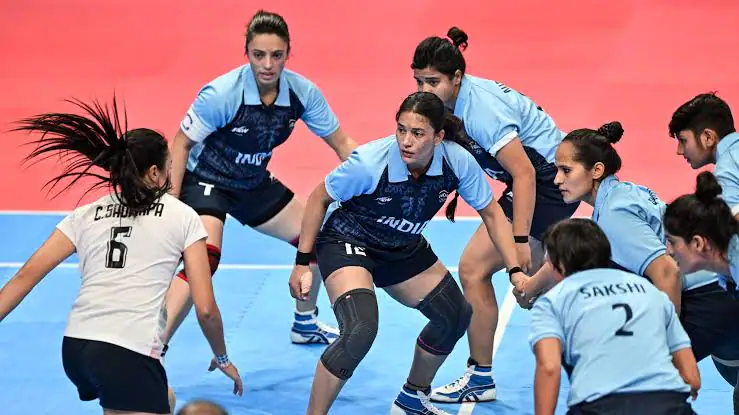
India’s men’s and women’s kabaddi teams are ready to defend their Asian Games gold medals at Aichi-Nagoya 2026. Here’s a look at the squads, groups and biggest threats.
India is going to Japan with two kabaddi gold medals to defend. And with that comes a simple expectation. Win them again.
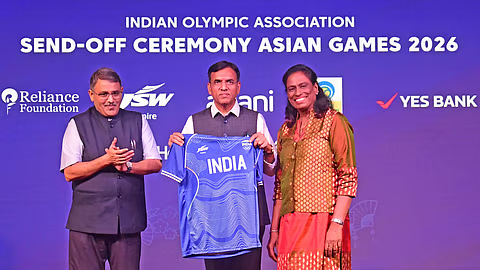
As the Sports Ministry cleared India’s 492-athlete contingent for the 20th Asian Games in Aichi-Nagoya, the men’s and women’s kabaddi squads were confirmed with full 12-player units. Both teams arrive as defending champions, having won gold at Hangzhou 2023. The challenge this time is not qualification.
It is repetition.
Kabaddi has historically been one of India’s strongest sports at the Asian Games. But history does not step onto the mat. A defending champion starts every tournament with the same score as everyone else.
And somewhere across the draw, Iran will be waiting.
The Indian men’s team has been assembled from a generation shaped by the Pro Kabaddi League. Pawan Sehrawat. Aslam Inamdar. Ashu Malik. Devank Dalal. Arjun Deshwal. Ayan Lohchab. Six raiding options. Six different ways to put points on the board.
That depth is perhaps India’s biggest advantage heading into the Asian Games. Sehrawat brings experience and the ability to change a match in a matter of raids. Malik has developed into one of the most consistent attacking players in the Indian system. Inamdar offers versatility. Deshwal provides proven scoring ability.
Then there are the younger options. Devank Dalal and Ayan Lohchab bring speed and unpredictability, two qualities that can become particularly valuable in short international tournaments where teams have limited time to recover and opponents are studying every pattern.
On the other side of the mat, India has experience. Sunil Kumar is the defensive anchor, supported by Jaideep Dahiya, Rahul Sethpal, Gaurav Khatri, Sumit Sangwan and Ankit Jaglan.
The names matter. But the balance matters more. India has raiders who can score in bulk. It has defenders capable of producing momentum-changing tackles. And it has enough depth to adjust combinations depending on the opponent.
That flexibility could become decisive. Because defending gold is rarely about playing one perfect match. It is about surviving six or seven different kinds of matches.
The Women Carry a Different Kind of Pressure
India’s women enter the Asian Games with an even stronger historical claim to dominance. The squad features Pushpa Rana, Sonali Shingate, Sanju Devi, Pooja Kajla, Ritu Negi, Ritu Sheoran, Jyoti Thakur, Pinki Roy, Manisha Kumari, Bhavna Thakur, Rajrani and Nikita Kumari.
There is experience in the group. There is continuity. And there is the pressure that comes with being the team everyone expects to beat.
Ritu Negi and Sonali Shingate provide leadership in a squad that also contains several players looking to establish themselves on the biggest continental stage. India’s women have been among the most consistent forces in Asian Games kabaddi history. That consistency is now both an advantage and a burden.
The advantage is belief. The burden is expectation. For the defending champions, a semi-final is not considered success. A silver medal will feel like a missed opportunity.
The target is gold.
Again.
The Draw Clears the Path. For Now.
The men have been placed in Group A alongside Bangladesh, Republic of Korea, Chinese Taipei and hosts Japan. India should be favourites to top the group.
But “should” is a dangerous word in sport. International kabaddi is no longer a competition where India can simply turn up and expect opponents to retreat. Teams have become better organised. Players are gaining experience through professional leagues and international exposure.
The real test is likely to come later. Iran, Pakistan, Malaysia, Nepal and Thailand make up Group B. The draw keeps the biggest men's heavyweights apart until the knockout rounds. That is where the championship could change. The women face a more demanding group.
India are in Group A with Iran, Japan and Bangladesh, while Group B consists of Sri Lanka, Thailand, Chinese Taipei and Nepal.
Iran and hosts Japan ensure India cannot afford a slow start. The top two teams from each group advance to the semi-finals. From there, one bad half can end everything.
Iran Remains the Shadow Over the Tournament
If there is one opponent India will prepare for more than any other, it is Iran. Iran’s men have become the most consistent challengers to Indian dominance in recent years. They won Asian Games gold in 2018 and have repeatedly shown that their physicality, defensive organisation and tactical discipline can disrupt India’s rhythm.
Their squad is led by legendary defender Fazel Atrachali and includes stars such as Mohammadreza Shadloui. Seven members of their 2023 silver-medal squad remain in the setup. They know what it takes to reach the final. They also know what it feels like to lose one to India.
Pakistan remains another serious medal contender in the men's event, although their current squad is relatively inexperienced compared with previous generations. For the women, Iran are rebuilding with a younger squad, with more than 80 per cent of the group changed since Hangzhou. They recently trained alongside Indian players in Sonipat, meaning both sides have had an opportunity to study each other closely before the Games.
Chinese Taipei, the women’s silver medallists in 2023, cannot be ignored either. Neither can home advantage. Japan may not enter as favourites, but competing in front of their own supporters could make them significantly harder to break down.
Favourites, But Not Untouchable
India enters Aichi-Nagoya as the team to beat in both competitions. The men have extraordinary raiding depth. The women have experience and continuity.
Both teams know what it takes to win Asian Games gold. But that does not mean the gold medals already belong to them. Iran’s defensive structure and physical intensity remain a genuine challenge. The shorter format of an international tournament also leaves little room for experimentation or recovery after a poor performance.
That is the reality of defending champions. Every team prepares for you. Every opponent wants your place.
And every match begins with the expectation that you will win. The kabaddi competition will unfold at the Tokai Citizens Gymnasium, where the continent’s biggest rivalries will return to the mat. For India, the equation is simple.
Two teams. Two gold medals to defend. The squads are selected. The approval has been secured. The countdown has begun.
Now comes the difficult part. Doing it again.
Comments (0)
to post comments, replies, and votes.
Loading comments…