Asian Games 2026: Can Pranavi Sharath Urs Hold On for Historic Golf Gold?
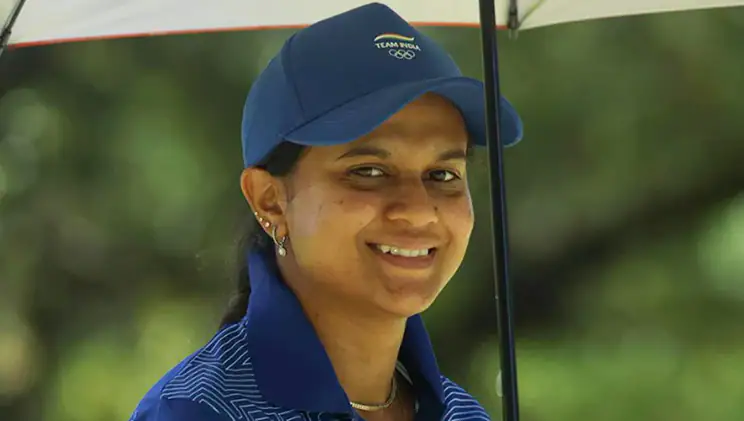
Pranavi Sharath Urs will begin the final round of the women’s individual golf competition at the Aichi-Nagoya Asian Games with something every golfer wants heading into the last 18 holes: a lead.
But the Indian is not simply leading the field. She has built a three-stroke advantage over Singapore’s Shannon Tan and a four-shot cushion over China’s Ruoning Yin, putting herself in a position to potentially deliver India’s first women’s individual golf gold medal at the Asian Games. Urs stands at 15-under-par 195 after three rounds of 66, 63 and 66. Tan is second at 12-under, while Yin is third at 11-under. The final group, which tees off at 7:54 AM JST, will therefore feature the three players who have separated themselves from the rest of the field.
The question is no longer whether Urs has played well enough to contend for gold. She clearly has. The question is whether she can convert her three-shot advantage over 18 holes against two players capable of producing exceptionally low scores.
Urs' advantage has been built on remarkable consistency. Her three rounds have all been under par, including a brilliant 63 in the second round. She has made only two bogeys across 54 holes, an important statistic given the difficulty of Kasugai Country Club's East Course. Her 15-under total means Tan needs to gain at least four shots on Urs across the final round to win outright if Urs finishes level with her. Yin needs to make up five.
That does not make the final round straightforward, but it gives Urs a valuable margin for error. The most encouraging aspect of her performance has been her ability to recover immediately after mistakes. In the third round, Urs made her first bogey in 48 holes on the par-4 14th. Rather than allowing that error to affect her finish, she responded with an aggressive approach from the left cart path on the 18th and converted a birdie.
That response could be crucial on Saturday.
Golf leads can disappear quickly, particularly on a course with four reachable par-5s. Kasugai's par-5s the 3rd, 8th, 13th and 17th offer the biggest opportunities for players trying to make up ground. A player who converts two or three of those opportunities into birdies can rapidly change the leaderboard.
This is where Shannon Tan remains a significant threat. The Singaporean opened the championship with rounds of 63 and 64, demonstrating that she possesses the scoring ability required to erase a three-shot deficit. Her eight-birdie opening round was one of the standout scoring performances of the tournament. Tan's problem came in the third round, when she struggled on the greens and posted a 1-over 71. She failed to convert a birdie putt outside tap-in range, allowing Urs to move from being part of a close battle to establishing a three-shot lead.
If Tan rediscovers the putting stroke that produced her first two rounds, the deficit could be dramatically reduced before the final nine.
Ruoning Yin cannot be overlooked
Four shots behind Urs, Ruoning Yin represents another major challenge. The Chinese star is the most decorated player in the final group, with a World No. 6 ranking and a 2023 Women's PGA Championship title on her résumé. More importantly, Yin has been extraordinarily consistent this week. Her three rounds have been 67, 66 and 66, meaning she has not yet shot higher than 67. That consistency makes her dangerous even from four shots behind.
Yin has also demonstrated that she can handle the changing conditions at Kasugai. As the greens became firmer and winds increased during the third round, she continued to produce a 66. For Urs, the objective therefore cannot simply be to watch Tan. Yin is close enough that a strong opening nine could bring her directly into the gold-medal conversation.
Urs' three-shot lead presents an interesting tactical problem. Playing too aggressively could introduce unnecessary mistakes. Playing too defensively could allow Tan and Yin to dictate the pace of the final round.
Her strongest route is likely to remain the formula that has taken her to 15-under: controlled ball-striking, smart positioning and attacking opportunities when the numbers are favourable. Her course-management strategy has focused on finding fairway positions that leave comfortable full-wedge and short-iron approaches. That allows her to control spin and attack flags without unnecessarily bringing difficult areas of the course into play.
That approach becomes even more important as the final round progresses. The closing stretch from the 14th to the 18th is particularly demanding. The 14th requires a long drive through a tree corridor, the 15th is a demanding par-3 of more than 200 yards, while the 18th requires an accurate approach to a green protected by greenside sand.
Urs has already shown she can close this stretch effectively.
The tournament data provides one particularly important benchmark: if Urs shoots 68 or better, she will secure gold regardless of what her immediate challengers do. That gives her a very clear target. A 68 would take Urs to 19-under-par, requiring Tan to shoot at least 65 simply to reach 19-under. Yin would need a 64 to reach the same total. Of course, golf rarely follows such straightforward calculations. A lower score from either challenger could put pressure on Urs, while a dropped shot or two from the Indian could suddenly bring both players into contention.
The key statistic remains her two bogeys in 54 holes. If she maintains that level of control, the chasing players will have to win the gold rather than wait for her to lose it.
The significance of Saturday goes beyond one medal. India's women's golf team has experienced painful near-misses at major multi-sport events, most notably Aditi Ashok's fourth-place finish at the Tokyo Olympics and her silver medal at the 2023 Asian Games after entering the final round with a seven-shot advantage. Urs now has the opportunity to write a very different ending. She leads a major championship final round by three shots, has produced three consecutive sub-par rounds, has surrendered only two bogeys and has already demonstrated the ability to respond immediately after mistakes.
But waiting behind her are two players with the scoring ability and experience to make the final 18 holes extremely demanding. Tan has already shown she can shoot 63.
Yin has shown she can produce three consecutive rounds in the 60s. Urs has the lead. Now she needs 18 more holes of the same disciplined golf that created it.
If she can maintain her fairway-and-green consistency and avoid giving her challengers early momentum, India's Pranavi Sharath Urs could finish Saturday not merely as the leader, but as the country's first female Asian Games golf champion.
Comments (0)
to post comments, replies, and votes.
Loading comments…