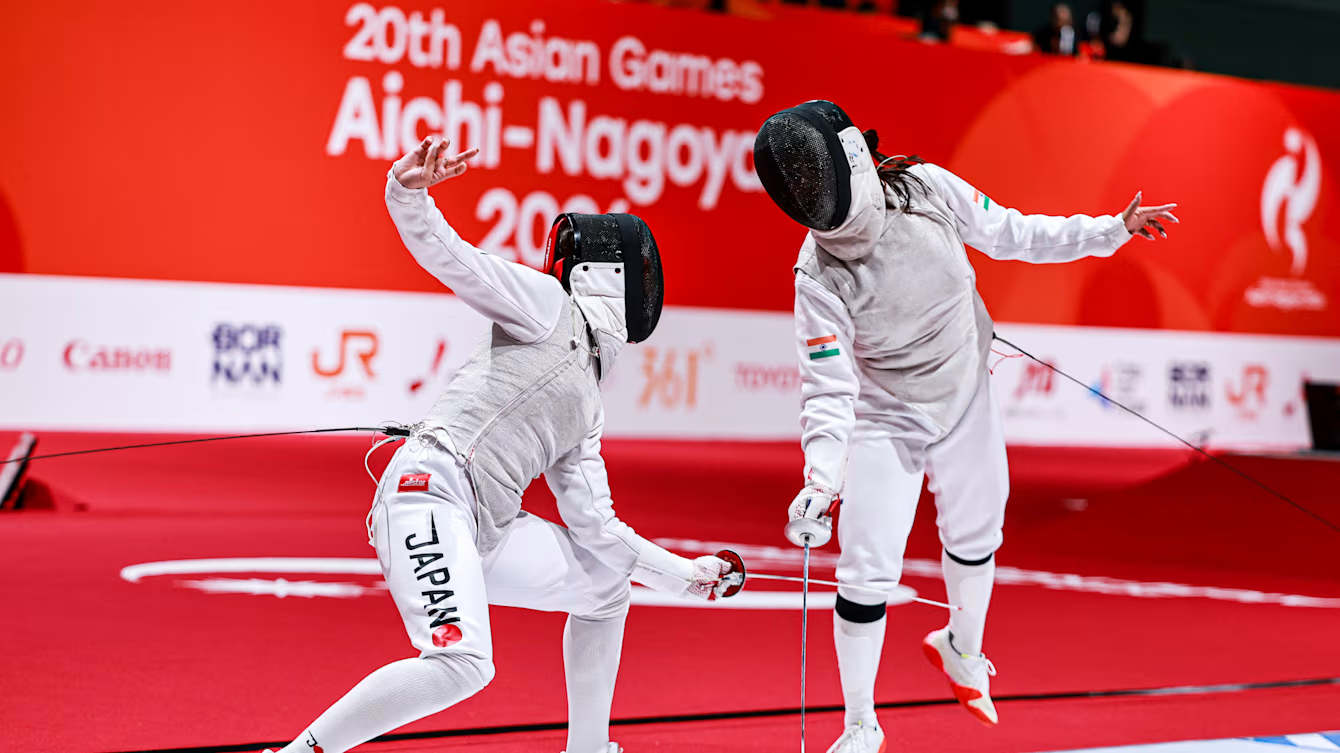
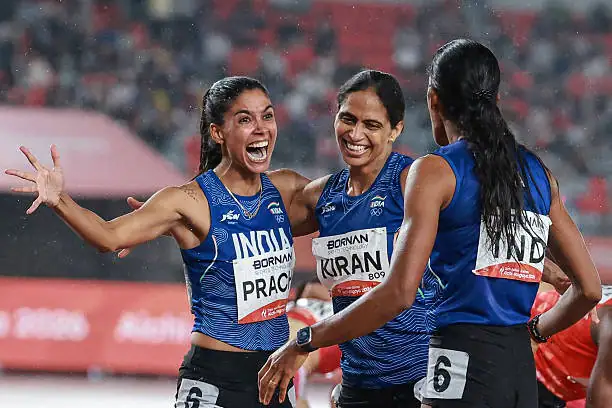
Asian Games 2026 Women’s Wrestling Preview: Can India Challenge Japan and China in Nagoya?
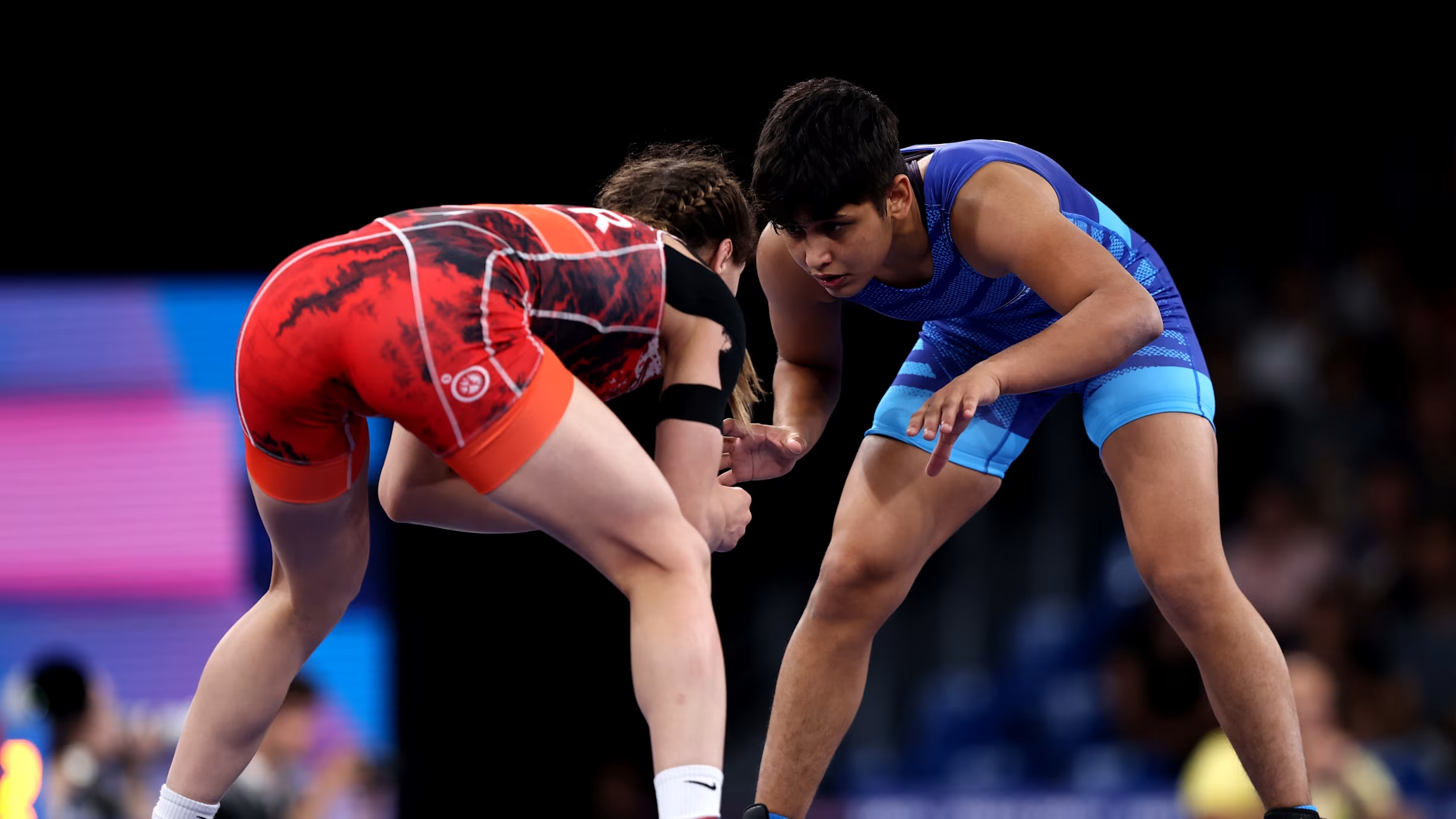
India’s women wrestlers will face one of the toughest fields of the Asian Games when competition begins in Nagoya on September 30.
The entry list across the six Olympic weight categories 50kg, 53kg, 57kg, 62kg, 68kg and 76kg brings together Olympic champions, World medallists and some of the strongest wrestling nations in Asia.
A total of 72 wrestlers representing 15 National Olympic Committees feature in the preliminary entry list. For India, the tournament represents an important opportunity for a young and changing women's wrestling team to test itself against a field dominated by Japan, China, North Korea and the Central Asian nations.
The biggest story of the competition, however, could be Japan's extraordinary strength across all six categories.
Japan enters with Olympic champions across the board
Japan has assembled a formidable women's wrestling team for its home Asian Games. Each of its six entries has either won an Olympic title or a senior World Championship, making the hosts the clear favourites to dominate the competition.
Yui Susaki leads the charge at 50kg. The Tokyo Olympic champion and four-time World champion remains one of the most technically complete wrestlers in the field. Her ability to defend attacks and immediately counter with explosive leg attacks makes her the benchmark in the lightest category.
At 53kg, Japan has Moe Kiyooka, a double U20 and U23 World champion who has already demonstrated that she can defeat India's Antim Panghal at senior level. The 57kg category could be even more intimidating. Akari Fujinami, the Paris 2024 Olympic champion, has moved up from 53kg and enters the Asian Games with an extraordinary unbeaten record. Her speed and precision make her the overwhelming favourite for gold.
Nonoka Ozaki at 62kg and Yuka Kagami at 76kg add two more Olympic-level champions to the Japanese lineup, while Ami Ishii gives Japan another major medal contender at 68kg.
With home advantage added to that depth, Japan will be difficult to stop.
If Japan is the favourite, China represents the most credible threat. China's entry list includes Olympic and World Championship medallists capable of disrupting Japan's expected dominance. At 50kg, Ziqi Feng is a major contender and has the physical game to challenge Susaki. Kexin Hong provides similar strength at 57kg, while Qi Zhang at 62kg brings World Championship pedigree and a powerful upper-body game.
At 68kg, Jia Long is another title contender, while Wenji Li will carry China's hopes in the heavyweight division.
China's approach contrasts with Japan's speed-based style. Its leading wrestlers are particularly dangerous in upper-body exchanges, underhook positions and high-amplitude throws. That could make several of the expected Japan-China matchups fascinating tactical battles.
India’s biggest medal hopes
India's women’s wrestling contingent may not enter as the favourite, but there are genuine medal opportunities across several categories. At 53kg, Antim Panghal is one of India's most established contenders. Her physical strength and ability to fight through difficult scrambles make her a dangerous opponent, even though she faces the major challenge of Japan's Kiyooka.
The 57kg category features Manisha, who arrives with momentum after producing a major upset against North Korea's World silver medallist Il Sim Son at the Ulaanbaatar Ranking Series. That victory showed that Manisha possesses the ability to beat highly ranked Asian opposition when she finds her rhythm.
At 62kg, Mansi Bhanwala enters as another realistic medal contender. Her route will be particularly challenging given the presence of Japan's Ozaki and China's Qi Zhang, but the Indian wrestler has already demonstrated her ability to reach the later stages of major continental competitions.
India's other significant opportunity comes at 68kg, where Nisha returns to major competition after an injury-interrupted period.
The heavyweight category could provide another intriguing storyline through Priya Malik, a two-time World U20 champion. At 76kg, she will face Olympic-level opposition, including Japan's Yuka Kagami and Kyrgyzstan's Aiperi Medet Kyzy, but her athletic power makes her one of India's most interesting prospects.
India's 50kg representative Dipanshi is also entering a highly competitive division featuring Susaki and China's Feng. For her, progressing deep into the bracket would itself represent an important achievement.
Kyrgyzstan could upset the established order
While Japan and China dominate the conversation, Kyrgyzstan could be the biggest spoiler. Meerim Zhumanazarova is a Tokyo Olympic bronze medallist and Paris Olympic silver medallist at 68kg. She brings enormous experience and a physical style that can trouble even the strongest opponents.
At 76kg, Aiperi Medet Kyzy is another genuine gold-medal contender. The multiple-time Asian champion and World silver medallist has established herself as one of the best wrestlers in the continent's upper weight classes.
North Korea also has the potential to disrupt the expected medal projections, particularly at 50kg and 53kg.
The Asian Games women's wrestling tournament will use the six Olympic weight classes and a single-elimination format with repechage opportunities for wrestlers beaten by finalists. Each bout will consist of two three-minute periods.
That format makes the draw extremely important.
For India, avoiding an early collision with one of the overwhelming favourites could prove crucial. At the same time, the repechage system means a quarterfinal defeat does not necessarily end a medal campaign.
The overall projection places Japan firmly on top, with China expected to finish second and Kyrgyzstan also tipped to challenge strongly. India is projected to finish fourth in the women's team standings, with a potential haul of one silver and three bronze medals.
Those projections are far from guarantees. Wrestling is a sport where one successful counter, one takedown or one late scramble can completely change a bout.
For India, the target should therefore be simple: convert its medal contenders into semifinalists and then make the most of every opportunity. Japan may have the strongest entry list on paper. China has the depth to challenge them, while Kyrgyzstan and North Korea can produce surprises.
India, meanwhile, has enough talent to make this a tournament worth watching closely.
The women's wrestling competition in Nagoya will begin on September 30, and by October 3, the Asian wrestling hierarchy could look very different or Japan could prove once again why it remains the continent's dominant force.
Comments (0)
to post comments, replies, and votes.
Loading comments…