India Aim to Improve on Sixth-Place Finish at 2022 Asian Games as Volleyball Squad Named for Aichi-Nagoya 2026
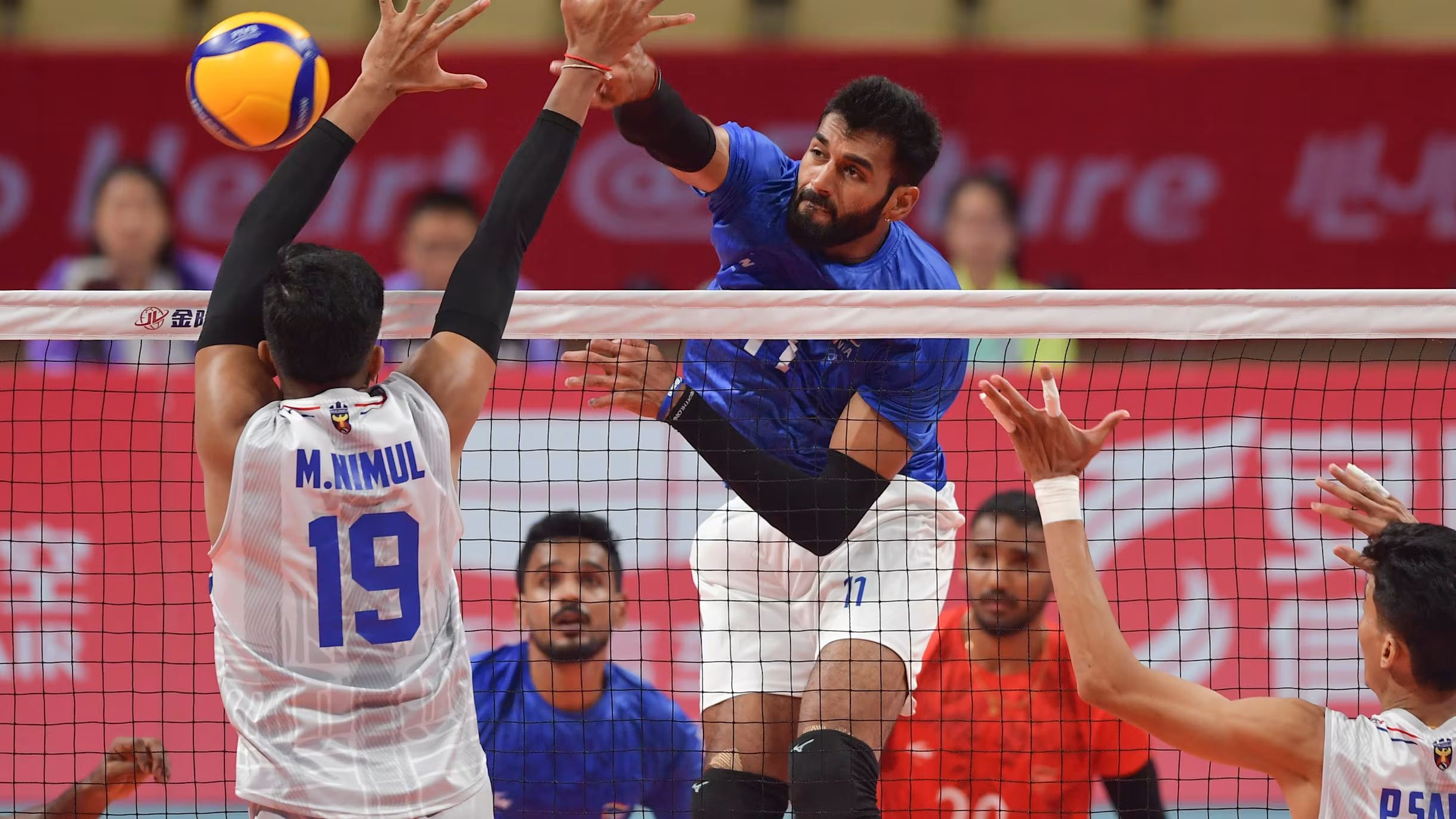
India’s men’s volleyball team will head to the 2026 Asian Games in Aichi-Nagoya with unfinished business from the previous edition firmly in mind.
After finishing sixth at the Hangzhou 2022 Asian Games, India will once again compete against the continent’s leading volleyball nations with the objective of taking the next step and making a deeper run in the competition.
The 12-member Indian squad has been named for the men’s volleyball tournament, scheduled from September 27 to October 3. India will begin their campaign against Vietnam on September 27 before facing Hong Kong China on September 28 and South Korea on September 29. The opening group itself presents an immediate opportunity for India to measure their progress since Hangzhou.
Most notably, the clash against South Korea will bring back memories of one of India’s strongest performances at the 2022 Asian Games.
India’s sixth-place finish at the previous Asian Games was built on several impressive performances. The Indian team opened its campaign with a straight-sets victory over Cambodia before producing one of the standout results of the tournament against South Korea. In a high-pressure five-set encounter, India defeated the Koreans 3-2 to finish ahead of them in the preliminary pool.
The result was significant not only because of the quality of the opposition but also because it demonstrated India’s ability to perform under pressure in a closely contested match. India carried that momentum into the next stage of the competition.
In the cross matches for the top 12, India faced Chinese Taipei and delivered another composed performance, winning 3-0. India took the match 25-22, 25-22, 25-21 to secure a place among the final six teams.
At that stage, India had established itself as one of the better-performing teams in the competition. Victories over South Korea and Chinese Taipei showed that the team could challenge established Asian opponents and consistently execute its game plan.
However, the campaign was halted by Japan. In the crucial match involving the final-six teams, Japan defeated India in straight sets, winning 25-16, 25-18, 25-17. Japan’s attacking quality and defensive organisation proved difficult for India to overcome, ending the team’s hopes of progressing into the medal matches.
India later lost their classification match against Pakistan and eventually finished sixth.
While the campaign ended without a medal, the sixth-place finish remains an important benchmark for the current generation.
The objective for Aichi-Nagoya 2026 will be straightforward: improve on sixth place. India has already shown that they can compete with teams such as South Korea and Chinese Taipei. The next challenge is to convert that ability into a longer and more consistent tournament run.
The 2026 campaign begins against Vietnam, followed by Hong Kong, China and South Korea on consecutive days. The quick turnaround between fixtures will place an emphasis on recovery, squad depth and consistency.
The South Korea match is likely to attract particular attention.
India’s five-set victory over the Koreans in Hangzhou remains one of the defining moments of their previous Asian Games campaign. The 2026 meeting will offer another opportunity to test whether India has maintained or improved upon that level.
According to the competition format, the top two teams from the pool will progress to the quarterfinals, scheduled for October 1. The semifinals will be held on October 2, with the gold medal match taking place on October 3.
For India, securing progression from the group will be the immediate priority. But the larger ambition will be to carry momentum into the knockout rounds and move beyond the final-six barrier.
Experience and emerging talent in the Indian squad
India’s 12-member squad features a blend of experienced players and younger names. Setter Muthusamy Appavu brings valuable experience, while Jerome Vinith Charles and Muhammad Nihal Chatham Kulangara are among the players expected to play important roles in the team’s campaign.
The squad also includes Chirag, Amit, John Joseph Eanthungal Joseph, Joel Benjamin Jebaraj, Anand Kottarathil, Om Vasant Lad, Ashwal Rai, Shikhar Singh and Erin Varghese. The group will have limited time to settle into the tournament. With matches scheduled on September 27, 28 and 29, India will need to find rhythm quickly before the knockout phase begins.
That makes the opening match against Vietnam particularly important. A positive start could provide momentum heading into the remaining group fixtures, while the match against South Korea could once again prove decisive in determining India’s position in the pool.
For Indian volleyball, the Asian Games provide one of the clearest opportunities to assess progress against the strongest teams on the continent. Hangzhou 2022 offered a mixed but encouraging picture. India was capable of producing high-quality performances and defeating strong opponents, but the loss against Japan also highlighted the gap that remained against Asia’s elite.
That remains the challenge in 2026.
India will not simply be looking for isolated victories. To improve on sixth place, the team must put together a complete tournament starting strongly, managing consecutive matches and delivering under pressure in the knockout rounds.
The squad named for Aichi-Nagoya has an opportunity to build on the foundation laid in Hangzhou. A repeat victory over South Korea would be another statement, but the ultimate measure of success will be how far India can progress beyond the group stage.
With the competition taking place on one of Asia’s biggest multi-sport stages, India’s volleyball team will have another chance to prove that its sixth-place finish in 2022 was not the peak.
Aichi-Nagoya 2026 could be the opportunity to go further.
India’s men’s volleyball squad for the 2026 Asian Games: Chirag, Amit, Muthusamy Appavu, Jerome Vinith Charles, Muhammad Nihal Chatham Kulangara, John Joseph Eanthungal Joseph, Joel Benjamin Jebaraj, Anand Kottarathil, Om Vasant Lad, Ashwal Rai, Shikhar Singh and Erin Varghese.
Comments (0)
to post comments, replies, and votes.
Loading comments…