India Make Archery History, Beat South Korea to Win First Asian Games Women’s Recurve Team Gold
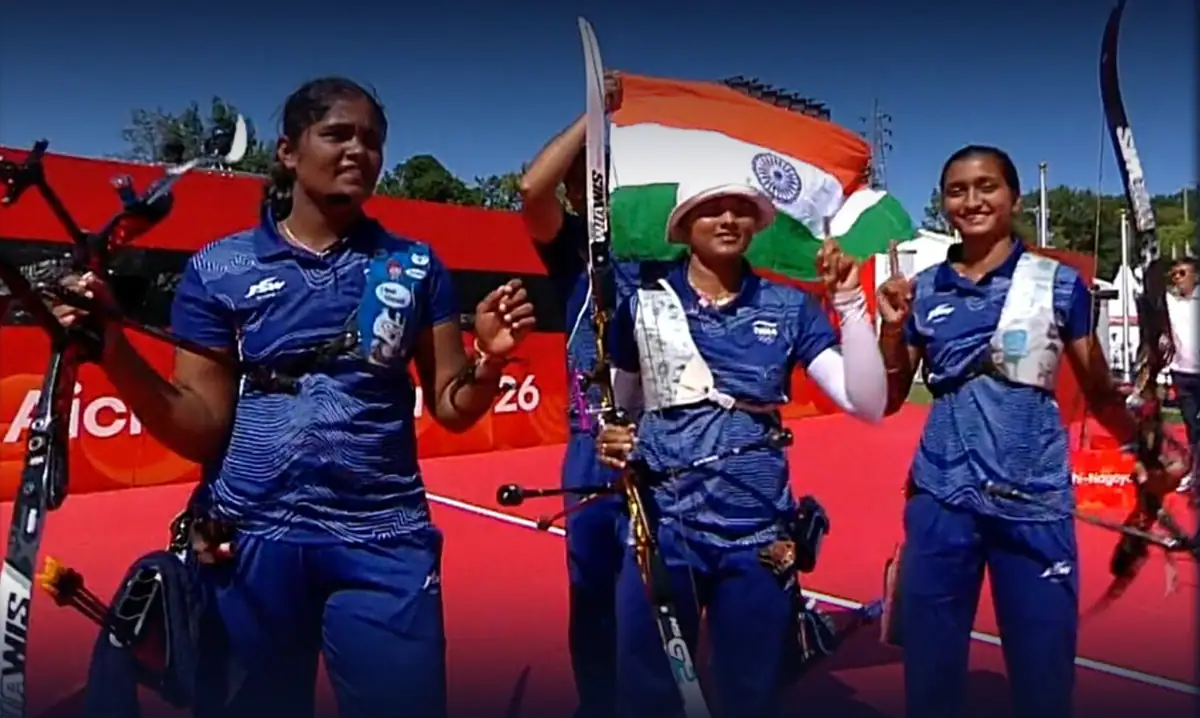
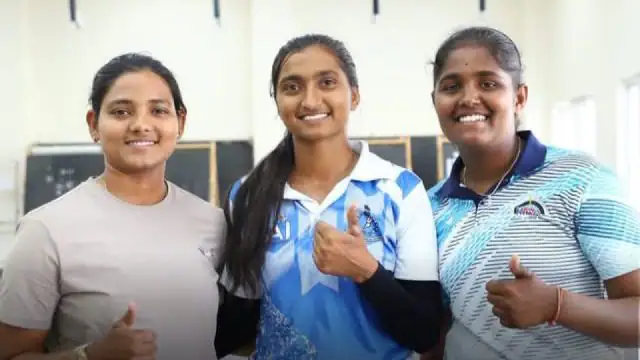
India created Asian Games history by defeating 10-time champions South Korea 5-3 to win their first-ever women’s recurve team gold, led by Kumkum Mohod, Ankita Bhakat and Kirti.
India has done what generations of Indian archers had been unable to do.
Kumkum Mohod, Ankita Bhakat and Kirti defeated South Korea 5-3 in the women’s recurve team final at the 2026 Asian Games, ending one of the most dominant records in the history of the event and delivering India’s first-ever Asian Games gold in the women’s recurve team competition.
It was a final decided by composure, recovery and, above all, the ability to produce the right arrow when the pressure was at its highest. And once again, it was 17-year-old Kumkum who produced the defining moment.
South Korea entered the final as the dominant force in the event, having won the women's recurve team title at every previous Asian Games edition since the event was introduced in 1978. India had never previously reached the summit clash. By the end of an extraordinary morning at Okazaki Chuo Sogo Park Multipurpose Square, that history had changed.
South Korea shot first in the opening set, with Yunji Lee producing 7 and 9, Chaeyoung Kang contributing two 10s and Yejin Oh adding two 9s. That gave Korea 54 points.
India changed the order used in the semifinal, sending Ankita Bhakat first, followed by Kirti and Kumkum. Ankita produced 9 and 9. Kirti followed with 9 and 7 before Kumkum delivered two 10s. India also finished on 54.
The set was tied, giving both teams one set point. It was an important opening because India had left points on the table, particularly through Kirti's second arrow, but Kumkum's perfect finish ensured the deficit did not become an early problem.
The match was level at 1-1.
Another Tie But Kumkum Keeps India Alive
The second set became another examination of India's ability to absorb pressure. South Korea raised the standard considerably.
Lee shot 10 and 10, and Kang produced 9 and 9, while Oh added another 9 and 9. Korea finished on 56. India had to match that. Ankita responded with two 10s, giving India the perfect start. Kirti then shot 8 and 8, leaving Kumkum with the responsibility of keeping India in the set.
Once again, she delivered. Two 10s from Kumkum brought India to 56, producing another tied set. The match remained locked at 2-2.
For India, the pattern was becoming clear: whenever a lower-scoring sequence threatened to open the door for South Korea, the team was finding a way to recover.
The third set was the turning point. South Korea struggled for consistency. Lee produced 8 and 8, Kang managed 10 and 8, while Oh shot 9 and 8.
Korea finished with only 51. India sensed the opportunity. Kirti was moved to the first position and responded with an important 10 before adding an 8. Ankita contributed 9 and 9, while Kumkum again finished strongly with 9 and 10. India reached 55, winning the set by four points. The scoreboard suddenly read 4-2.
India needed just one more set point to become Asian Games champions. South Korea, meanwhile, had to win the fourth set outright to force a shoot-off.
The fourth set produced the most pressure-filled passage of the final. South Korea knew there was no margin for error. Lee opened with a 9, Kang followed with another 9 and Oh added a 10. Korea began with 28/30, immediately placing the pressure on India. Kirti shot a 9, but Ankita followed with an 8. Kumkum added a 9, leaving India on 26 after the first rotation.
Korea led 28-26. But India's response was exactly what was required. Kirti added an 8. Ankita followed with a 9. That left Kumkum needing only a 7 to give India the set. She shot a 10. India finished the set on 55-51, moving to 4-2. At that point, India needed only a tied set to win gold.
South Korea needed another set victory merely to force a shoot-off.
The fifth set carried the weight of decades of South Korean dominance. South Korea opened with Lee shooting 9 and 8, Kang producing 9 and 9, and Oh delivering 10 and 9.
Korea finished on 54. India needed 54 to tie the set and claim the gold. Kirti shot an 8 with her first arrow, but the arrow was subsequently checked and upgraded to a 9.
Ankita then produced 8 and 9. The final responsibility again fell to Kumkum. She delivered a 9 and a 10. India reached 54. The set was tied.
And with that, the match was won. India 5-3 South Korea.
The significance of the victory goes beyond one medal. South Korea had never lost a women's recurve team final at the Asian Games since the event was introduced in 1978. India had never even reached the final before 2026. Now India are Asian Games champions. The victory also underlines the extraordinary contribution of Kumkum Mohod throughout the final. Whenever India needed a high-pressure arrow, the 17-year-old repeatedly found the centre of the target.
Ankita provided the experience and stability required in a final of this magnitude, while Kirti contributed crucial scores despite facing intense pressure during several stages of the contest. Most importantly, the three archers stayed together as a unit.
India did not win because every arrow was perfect. They won because every difficult moment was followed by a response. For years, South Korea represented the summit of women's recurve team archery at the Asian Games. On October 2, 2026, India finally reached that summit and then took the gold.
India are Asian Games champions in women's recurve team archery for the first time.
Comments (0)
to post comments, replies, and votes.
Loading comments…