India Misses Out on Asian Games 2026 3x3 Basketball After Men and Women Competed in Hangzhou
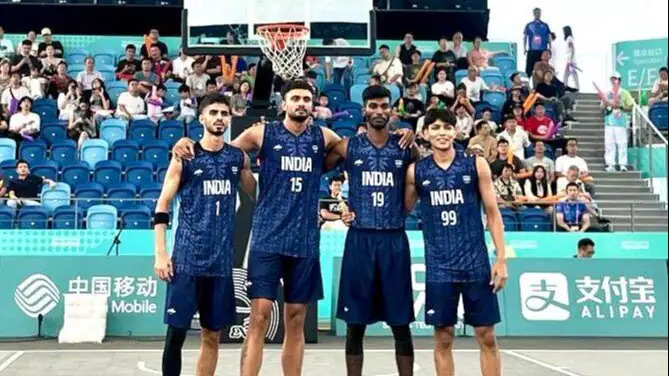
India will not have representation in either the men’s or women’s 3x3 basketball competitions at the Asian Games 2026, marking a significant change from the previous edition in Hangzhou, where both Indian teams took the court.
The draw for the 3x3 basketball competition in Aichi-Nagoya has been finalised, and India does not feature in any of the four pools in either the men’s or women’s event. The absence means that both Indian teams that participated at the last Asian Games have missed out on a place at the 2026 edition. At Hangzhou 2023, 3x3 basketball provided India with an opportunity to compete against some of the strongest teams in Asia. While neither the men’s nor women’s team reached the medal positions, their participation ensured India had representation in both categories of a rapidly growing Olympic discipline.
That will not be the case in Aichi-Nagoya.
India competed in both events at the last Asian Games
At the previous Asian Games, the Indian men’s 3x3 basketball team finished 10th in the overall standings with two wins from four matches. India defeated lower-ranked opposition but found the going tougher against stronger Asian teams as the competition progressed.
Chinese Taipei topped the men’s standings with seven wins from eight matches, followed by Qatar and Mongolia. South Korea, China, Japan, Iran and the Philippines also finished ahead of India. The Indian women’s team also competed in Hangzhou and finished eighth in the standings. India registered one victory from four matches, with China, Mongolia, Japan, Chinese Taipei and South Korea occupying the leading positions.
The participation of both teams was important for Indian basketball because 3x3 has become a distinct high-performance discipline rather than simply a shorter version of traditional five-on-five basketball. The format demands different skills, greater physical endurance and rapid decision-making. With just three players on court, there is limited room to hide defensive weaknesses, while the 12-second shot clock forces teams to attack quickly.
For India, the Asian Games represented valuable exposure against teams that have established deeper systems in 3x3 basketball.
No place in the 2026 Asian Games draw
The 2026 draw, however, presents a different picture. In the men's competition, the participating teams have been divided into four pools. Pool A includes Mongolia, the Philippines, Kazakhstan and Sri Lanka. Pool B features China, Iran, Malaysia and Hong Kong.
Qatar, Indonesia, Chinese Taipei and Bahrain have been drawn in Pool C, while hosts Japan, Singapore, South Korea and Thailand form Pool D.
India does not feature in any of the 16-team men's field. The women's draw has also been completed without India.
China, Kazakhstan, Qatar and Sri Lanka have been placed in Pool A. Japan, Chinese Taipei, Iran and Uzbekistan make up Pool B. Mongolia, the Philippines, Malaysia and Macau are in Pool C, while Singapore, Indonesia, Thailand and South Korea form Pool D.
Once again, India is absent. The development means Indian basketball will have no 3x3 representation in either gender category at one of Asia's biggest multi-sport events.
The absence is particularly notable because India had managed to qualify both teams for the previous Asian Games. While qualification for a continental multi-sport event is never guaranteed, missing out entirely after fielding men's and women's teams at the last edition raises questions about India's progress in the discipline and the pathway available to elite 3x3 players.
3x3 basketball has grown considerably on the international stage since being introduced to the Olympic programme. The shorter format has its own ranking system, specialist tournaments and qualification structure, requiring sustained participation and performance rather than occasional international appearances.
For India, remaining competitive requires regular exposure against high-level opposition and a dedicated pool of players capable of adapting to the specific demands of the format. The 2026 Asian Games field also underlines the depth of competition in Asia.
Traditional basketball powers such as China, Japan and South Korea are present in both categories. Mongolia, one of the strongest nations in international 3x3 basketball, also features in both events. Other teams such as Qatar, Iran, Chinese Taipei, Kazakhstan and the Philippines add further depth to the competition.
The absence of India, therefore, cannot be viewed in isolation. The challenge for qualification has intensified as more Asian nations invest in the format.
Missing the Asian Games removes an important competitive platform for Indian 3x3 basketball players. The Games offer athletes the opportunity to compete in high-pressure matches against some of the continent's best teams. Such exposure can be critical for player development, particularly in a discipline where experience, chemistry and quick tactical adjustments play a major role.
It also means India will lose visibility at a time when 3x3 basketball continues to gain international importance. The immediate focus for Indian basketball will now have to shift towards rebuilding the competitive pathway. Developing specialist 3x3 teams, increasing participation in ranking events and providing more regular international competition could be crucial for improving India's future prospects.
There is no shortage of basketball talent in India, but translating that talent into consistent international results requires a structured approach specific to the 3x3 format. The gap between participation and sustained competitiveness remains one of the biggest challenges.
India's absence from both the men's and women's 3x3 basketball events at Asian Games 2026 is a step back from the representation achieved in Hangzhou. At the previous edition, both teams earned the chance to compete on the Asian Games stage. This time, neither will make the trip to Aichi-Nagoya. For Indian 3x3 basketball, the disappointment should also serve as a reminder of what is required to return stronger.
The Asian Games 2026 will go ahead with 16 teams in each competition, featuring many of Asia's established and emerging 3x3 nations.
India will be watching from outside the draw.
The challenge now is to ensure that this absence becomes temporary and that the next Asian Games cycle sees Indian men and women return to the continental stage with stronger qualification prospects and greater ambitions.
Comments (0)
to post comments, replies, and votes.
Loading comments…