India’s Canoeing Team for Asian Games 2026: Can the New Squad Go Beyond the 2022 Bronze?
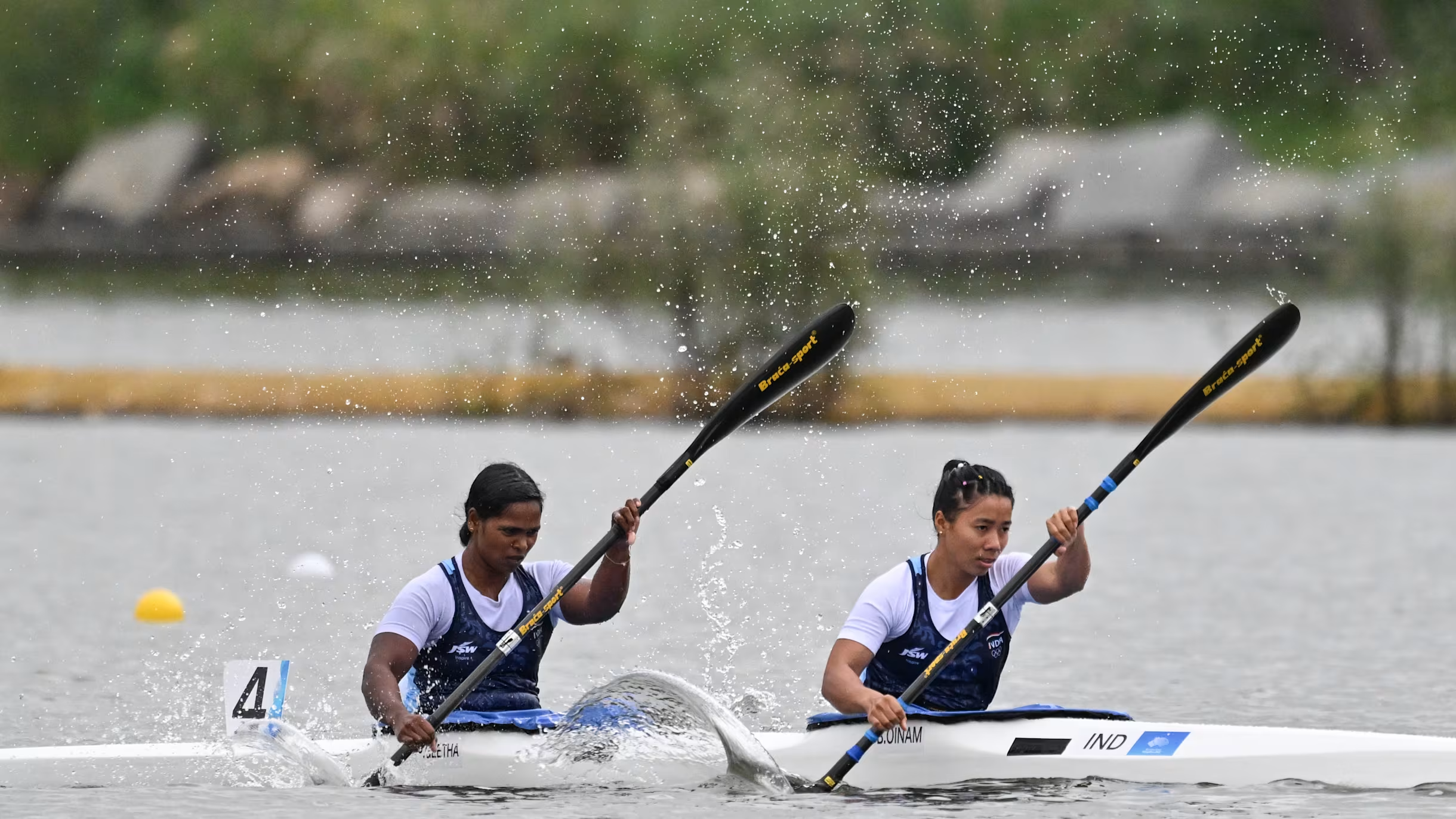
India's canoeing campaign at the 2026 Asian Games will begin with a relatively modest benchmark but a significantly changed squad.
Four years after the country won one bronze medal in Hangzhou, the Indian team heading to Aichi-Nagoya features a mix of returning names and new combinations across canoe sprint and slalom. The 2022 results showed that India could break through for a podium finish, although the overall medal table demonstrated just how difficult the competition remains. China dominated canoeing with 12 gold medals and 13 medals overall, while Chinese Taipei won three medals and Kazakhstan collected 11.
India finished 10th in the canoeing medal table with one bronze. That bronze came in the men's C-2 1000m sprint, where Arjun Singh and Sunil Singh Salam finished third.
India's strongest result in Hangzhou came from Arjun Singh and Sunil Singh Salam. The pair clocked 3:53.529 in the men's C-2 1000m final to secure the bronze medal. It was India's only canoeing medal at the Games, coming in an event where the country's athletes had to contend with a deep field dominated by the leading Asian canoeing nations.
Arjun and Sunil's medal therefore provided an important result for Indian canoeing, but the rest of the 2022 campaign was largely marked by finishes outside the podium positions. In slalom, Hitesh Kewat finished seventh in the men's K-1 final, while Vishal Kewat was seventh in the men's C-1. Shikha Chouhan finished sixth in the women's K-1.
The sprint events also produced several finalists, although none could match the C-2 men's bronze. Four years later, the challenge is to turn that isolated podium finish into a broader medal challenge.
The 2026 men's sprint team has undergone a substantial change. The new men's C-2 500m pairing is Gyaneshwar Singh Philem and Raju Rawat. The team also includes Prohit Bairo and Prasanna Kumar Chempadiyil in men's K-2 500m, while a larger group will contest the men's K-4 500m.
Notably, Arjun Singh and Sunil Singh Salam's 2022 C-2 1000m bronze-winning combination is not listed in the 2026 squad. That means India will be looking to a new generation of sprint combinations to deliver the country's next breakthrough.
The women's sprint program is similarly broad. Soniya Devi Phairembam is listed for the women's C-1 200m, while Neha Devi Leichonbam and Megha Pradeep will compete in the women's C-2 500m. There are also women's K-2 and K-4 combinations, with Soniya Devi, Dhanamanjuri Devi Khwairakpam, Parvathy Geetha and Pooja among the athletes named across the events.
The 2026 team therefore has greater representation across several sprint combinations, although the absence of the 2022 medal-winning C-2 pairing means the team will need to establish itself afresh.
Slalom brings a familiar name.
The slalom squad has a clearer connection with the previous Asian Games. Hitesh Kewat returns after reaching the men's K-1 final in Hangzhou. He finished seventh in 2022 after recording a final time of 130.34. This time, however, Hitesh is listed for the men's K-1 as well as the men's Kayak Cross, where he will compete alongside Pradhyumna Singh Rathod.
Rathod also joins Hitesh in the new men's Kayak Cross event, giving India another opportunity to challenge in a discipline that was not part of the same 2022 results structure shown here. The women's slalom line-up also contains a combination of experience and new faces. Pallavi Jagtap and Rina Sen are listed for women's K-1, while Shikhia Chouhan returns to the squad.
Chouhan's previous Asian Games experience could prove useful. She finished sixth in the women's K-1 final in 2022 after qualifying through the heats and semi-final.
Can India move beyond one medal?
The biggest question surrounding the 2026 team is whether India's expanded participation can translate into a better medal return. In 2022, India had one bronze from canoeing. China won 12 gold medals, while Kazakhstan collected one gold, five silver, and five bronze medals. Even countries such as Uzbekistan and Japan had multiple podium finishes.
India's task is therefore not simply about improving its own performances. It is about closing a considerable gap with the continent's established canoeing powers. The 2026 squad has opportunities in both sprint and slalom, and the inclusion of multiple team combinations could give India more chances to reach finals.
But the composition of the team also makes predictions difficult. The men's C-2 1000m pair that delivered India's only medal in 2022 is no longer the combination heading to Aichi-Nagoya. Instead, the focus shifts to athletes such as Gyaneshwar Singh Philem, Raju Rawat, Hitesh Kewat, Pradhyumna Singh Rathod, and the women's sprint combinations.
India's canoeing campaign in 2022 was ultimately defined by one moment: Arjun Singh and Sunil Singh Salam taking bronze. The 2026 team enters with no such established medal combination to fall back on. That could be viewed as a disadvantage, but it also gives the new squad an opportunity to create its own story.
Hitesh and Shikhia bring Asian Games experience from Hangzhou, while several of their teammates will be chasing their first major continental podium. India finished 10th in the canoeing medal table in 2022.
Four years later, the target is simple: turn that solitary bronze into a stronger overall campaign and prove that Indian canoeing can compete for medals across more than one event.
Comments (0)
to post comments, replies, and votes.
Loading comments…