The Long Road to Asian Games at Aichi-Nagoya: How Indian Women’s Rugby Has Evolved
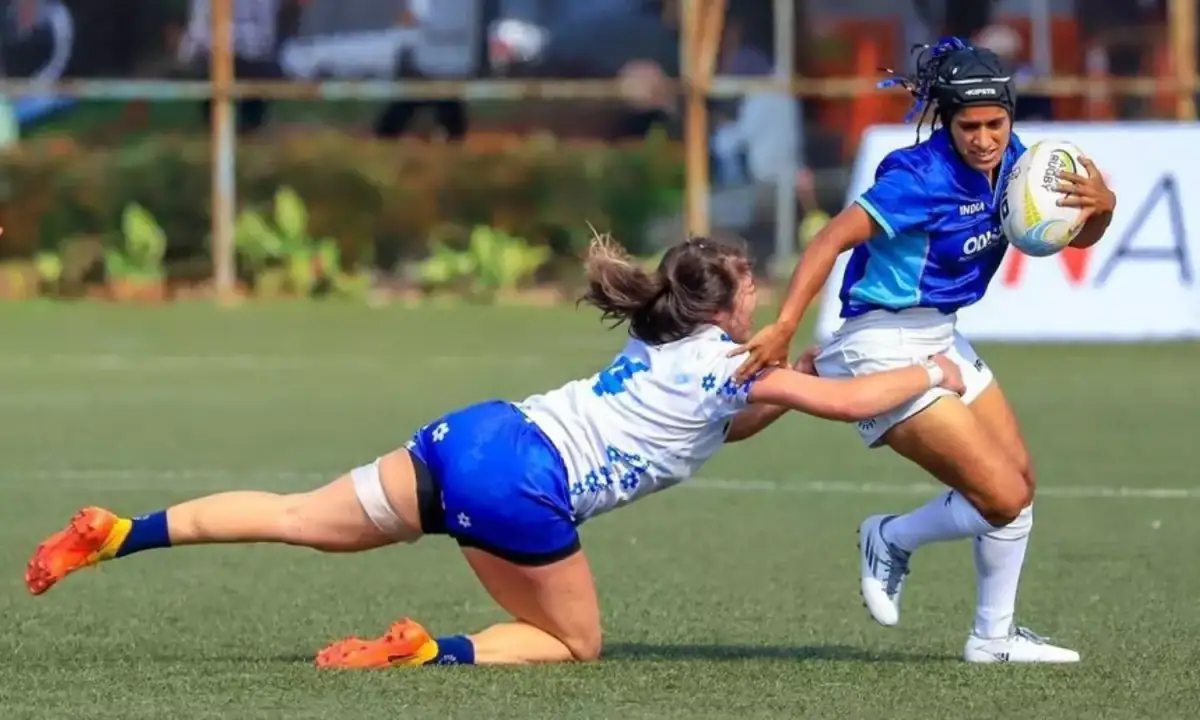
India’s rugby campaign at the Asian Games gets underway today, with the women’s team kicking off against Hong Kong China in the opening match of their pool-stage campaign.
Men last made it to the Asian Games in 2010, and for the second time at the Asian Games, it is the women carrying India’s rugby hopes on their shoulders, with the men’s team missing out on a place in the competition.
For Captain Shikha Yadav, this is more than another Asian Games campaign. It is another marker of how far Indian women’s rugby has travelled and of the generation that helped build the road she now leads.
For years, Indian women’s rugby was sustained by players who had little more than the game itself.
There were limited facilities, little financial support and even less certainty about where rugby could take them. Some balanced training with jobs and studies. Others played tournaments whenever the opportunity came, simply because there was a game to play.
Shikha Yadav knows that history well.
The Indian women’s rugby captain is now preparing for her second Asian Games, seven years after she first picked up the sport. But her journey to the captaincy is also a story about the players who came before her - and the rugby ecosystem they helped build.
When Shikha joined Delhi Hurricanes, a popular rugby club in New Delhi that has produced several national-team players over the years, the difference was immediate.
She had come from individual sports, where the focus was largely on her own performance. Rugby forced her to look outward - to understand different personalities, communicate with teammates and learn how to bring people together.
The senior players at Delhi Hurricanes showed her how.
She remembers watching players such as Priya Bansal and Namita Bhoj, seeing how they kept the team together on and off the field. There was a simple philosophy behind it: if one player was tackled, her teammates had to feel as though they had been tackled too.
For Shikha, that bond became one of the reasons she wanted to stay in rugby.
The sport was building her career, but it was also building her as a person. Her career, meanwhile, took an unusual route.
Yadav started playing rugby in 2017, at 17. Two years later, she was already in India's senior setup. In June 2019, she was part of the Indian team at the Asia Rugby Women's Championship Division 1 in Manila.
Then came the unusual part.
In August that year, Yadav finally played at an age-group international tournament - the Asia Rugby Under-20 Girls Sevens Championship in Vientiane, Laos. India won bronze.
She had, in effect, played senior rugby before playing junior international rugby.
That early exposure meant that when she eventually found herself playing alongside players much older and more experienced than her, she had to learn quickly. She credits those seniors with giving her the maturity that eventually became one of her biggest strengths as a leader.
“I’m very grateful that I got such seniors who brought me to this maturity level,” she says.
That gratitude extends beyond the players who directly mentored her.
Yadav thinks about the generation that represented India at the 2010 Asian Games, when women’s rugby made its Asian Games debut, and the players who continued to play when there was little infrastructure around them.
Back then, some were juggling rugby with jobs and studies. The objective was often much simpler: find an opportunity to play.
Today, the environment looks different. India has a more structured high-performance system, with sports science, nutrition, psychology, GPS tracking and load monitoring now part of the programme. And the women's Rugby Premier League made its debut in 2026, giving Indian players another competitive platform.
Shikha believes the players of her generation can only benefit from that because the women before them kept pushing when the pathway barely existed.
“If they weren't there, where would we have come from?” is the essence of her argument.
There is perhaps no better way to understand that transition than through another Shikha.
Shikha Thakkar is not the captain whose name now appears on India's team sheets. She is the woman working behind the scenes as manager of high performance for all categories, men's, women's, and U18 and U20, as well as XV, and she is part of the support staff travelling with India's Asian Games team.
But Thakkar's relationship with Indian women's rugby goes back much further.
She started playing in school, went on to play herself, and later moved into coaching and team management. She was selected as an assistant coach with the senior India women's team in 2021 and subsequently moved into team management. In 2022, she travelled with the Indian women's side to the Asia Rugby Sevens Championship in Jakarta, where India won silver.
Her journey is almost a mirror image of the sport's evolution.
She played when rugby was still trying to establish itself. She then coached the next generation. Today, she works in high performance, helping create the systems around the players who now represent India.
Captain of the women’s team, Shikha, speaks with particular respect about the senior players who continued playing despite having to build careers and manage their own lives alongside rugby. They were not just competing for themselves, she believes. They were creating the pipeline for those who would follow.
Now, the skipper is one of those players.
She has already experienced an Asian Games in Hangzhou and was part of India's silver-medal runs at the Asia Rugby Sevens Trophy in 2023 and 2024. She also captained India during its first-ever Asia Rugby Emirates Sevens Series campaign in 2025.
And ahead of Aichi-Nagoya, her message to her teammates is not really about the scoreboard.
When faced with difficult situations, she says, the team focuses on what it can control - its processes, its cues and the things it has practised.
It is a fitting philosophy for a captain whose own journey has been shaped by a process that began long before she wore the armband.
Seven years ago, Shikha was the young player learning from the seniors around her.
Today, she is one of the seniors.
And somewhere between the Shikha who played rugby for the first time in Delhi and the Shikha now working behind India's high-performance programme is the story of Indian women's rugby itself - a sport that is slowly moving from fighting for opportunities to building a pathway for the women who come next.
Comments (0)
to post comments, replies, and votes.
Loading comments…