Vithya Ramraj Anchors India to Women’s 4x400m Gold in a Dramatic Asian Games Finish
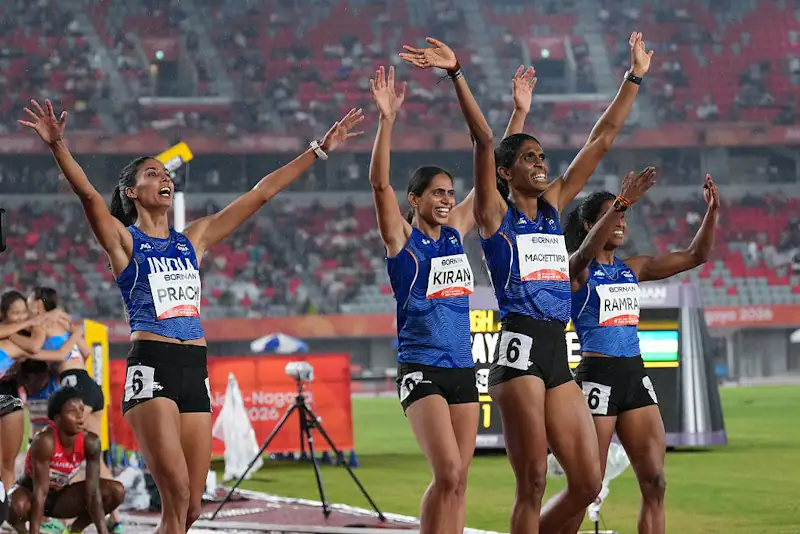
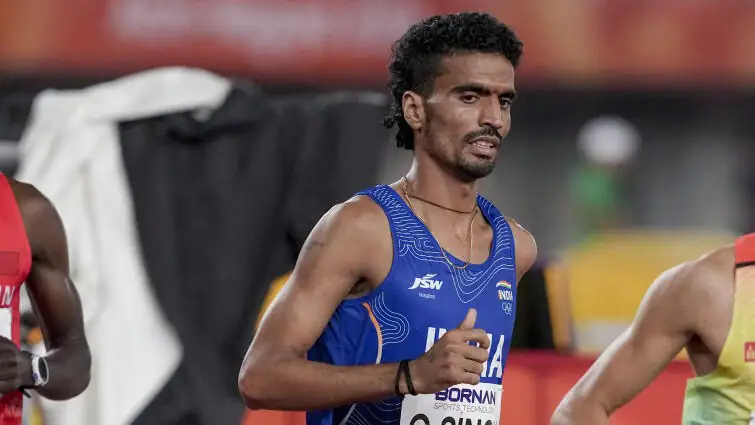
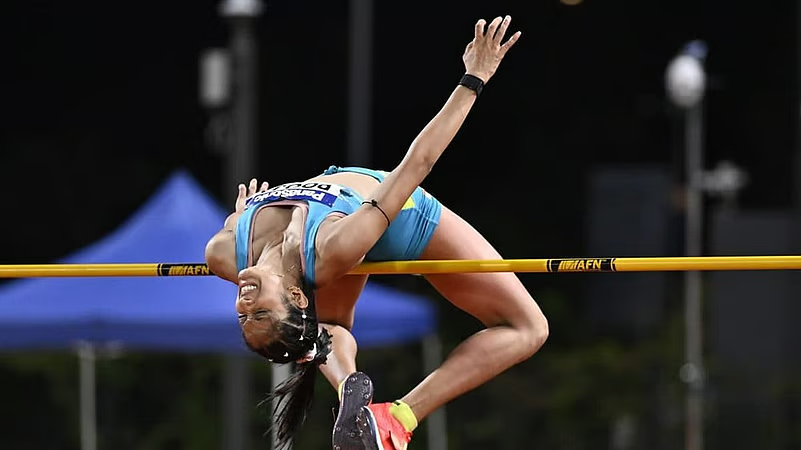
India’s women’s 4x400m relay quartet delivered the defining track-and-field moment of its Asian Games campaign, winning gold in a dramatic final that saw Vithya Ramraj produce a decisive final-leg surge to hold off Bahrain and restore India’s place at the top of the continental relay podium.
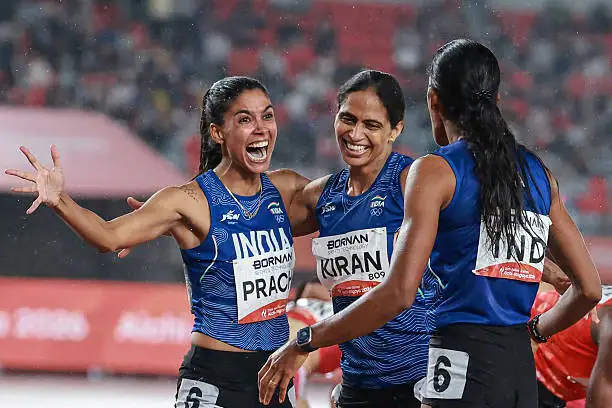
The quartet of Kiran Pahal, MR Poovamma, Prachi and Vithya Ramraj overcame an early deficit, moved into medal contention through the middle legs and then relied on Vithya’s extraordinary closing speed to seal the gold.
The victory was particularly significant because it ended India’s wait for an athletics gold at these Games.
India's opening leg was handled by Kiran Pahal, who entered the final bend in third position. The Indian team was therefore not in front when the first baton exchange approached. Kiran's task was to keep India within striking distance, and she handed over with the team still firmly in medal contention.
That brought veteran MR Poovamma onto the track. Poovamma immediately increased the pace as the lanes began to merge. Her experience became important at precisely the moment the race opened up, as India moved from third into second place.
The acceleration changed the shape of the race. India was now chasing the Chinese runner while Bahrain remained close enough to threaten the podium positions. Poovamma eventually brought India into the exchange with Prachi, who had already won an individual bronze medal in the 400m earlier in the Games.
Prachi keeps India in the fight
Prachi received the baton with India in a strong position and had a clear objective: keep the gap to the leader manageable and ensure Vithya received the baton with the gold medal still within reach. She did exactly that. The Indian runner stayed in the contest through the third leg before handing over to Vithya Ramraj, who had already transformed her own Asian Games campaign just 24 hours earlier.
Vithya had broken the legendary PT Usha 400m hurdles national record in the individual event, producing a 54.75-second bronze-medal performance. Now she had one final 400m to run.
And this time, it was for gold. Vithya changes the race Vithya did not hesitate. She immediately launched into her final-leg charge and began closing the gap to the runners ahead.
By the time she reached the 200m mark, the Indian had made up the ground and moved clear. But the race was not over. Bahrain's Salwa Eid Nasr was closing rapidly. The Bahraini runner, receiving the baton last, began hunting down the leaders and threatened to turn the final straight into another dramatic finish.
Vithya, however, had enough left. She maintained her speed through the closing stages and resisted Bahrain's late challenge. Then came the finish.
India had won gold.
The quartet's victory delivered a moment of enormous significance for Indian athletics and specifically for the women's 4x400m relay, an event with a long association with the country's track-and-field identity.
For Vithya, the relay gold completed an extraordinary three-medal Asian Games campaign. She leaves Nagoya with one bronze, one silver and one gold. The bronze came in the 400m hurdles, where she broke PT Usha's national record with her 54.75-second run. She then added a silver medal before returning for the relay final and producing the performance that ultimately delivered gold for India.
That sequence makes the relay victory particularly remarkable. Vithya was not entering the final as a fresh athlete with an untouched programme. She had already carried a heavy individual workload, including the emotional and physical demands of breaking a national record. Yet when India needed its final runner to close the race, she produced another decisive effort.
The victory also carried a strong historical connection. PT Usha's name has long been intertwined with India's women's 4x400m relay success and the country's emergence as a serious force in Asian athletics during the 1980s and 1990s. The new generation has now provided another reminder of that legacy.
The quartet of Kiran, Poovamma, Prachi and Vithya did not win by controlling the race from the opening metres. Instead, they built their victory progressively.
Kiran kept India close. Poovamma moved the team into second. Prachi maintained the position. Then Vithya delivered the decisive acceleration. That progression made the final particularly compelling. India's gold was constructed across all four legs, but it was Vithya's final burst that converted the opportunity into victory.
The significance of the medal was also reflected in the broader athletics picture. Without this gold, India would have faced the prospect of completing its first Asian Games athletics campaign without a track-and-field gold since 1994. Instead, the women's 4x400m team ensured the streak continued.
For Kiran Pahal, MR Poovamma, Prachi and Vithya Ramraj, the result is a gold medal. For Indian athletics, it is another chapter in the long 4x400m relay story.
And for Vithya, it is the perfect conclusion to a Games in which she has collected three medals across three demanding performances.
The final baton had to reach the line first.
Vithya made sure it did.
Comments (0)
to post comments, replies, and votes.
Loading comments…